Context
In remote parts of Manica Province, many people lack regular and timely access to healthcare. Long travel distances, poor roads, seasonal flooding, and a limited number of health facilities disrupt continuity of care. During the rainy season, some villages can only be reached on foot or by motorcycle.
These barriers particularly affect women and other vulnerable groups. For example, they may struggle to attend antenatal check-ups, complete vaccination schedules, or receive follow-up care for HIV and tuberculosis. Travel costs, care responsibilities, limited mobility, and insufficient information create additional barriers.
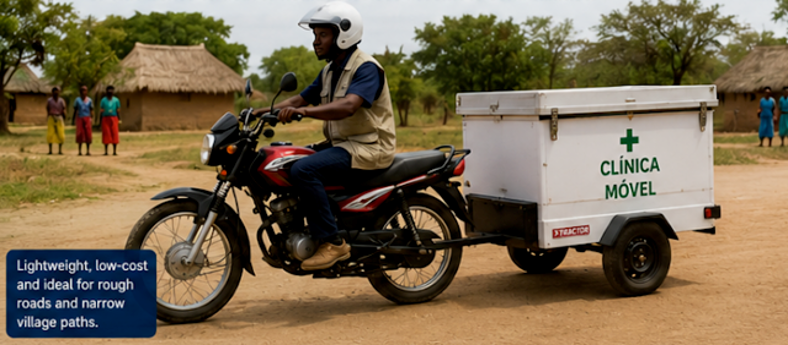
The innovation therefore explores a lightweight and flexible motorcycle-based healthcare model. Rather than replacing the existing health system, this model strengthens the connections between remote communities, local health workers, health centres and referral facilities. This will enable the public health system to reach people more frequently and provide care closer to their homes.
Project goal and outputs
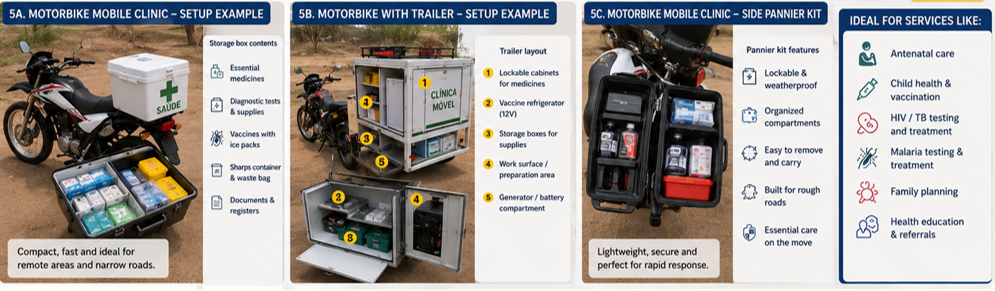
This project aims to assess the technical, operational, social and economic feasibility of a modular last-mile healthcare system for remote communities. The proposed system combines a motorcycle with a medical cargo trailer, portable diagnostic equipment, cold-chain solutions and digital tools for patient registration and referral.
During the first phase, the partners will map the local health system and identify the main barriers to accessing healthcare. They will consult women, local health workers, traditional birth attendants, community leaders, healthcare professionals and public authorities. Through joint design sessions, they will determine which services, routes, working methods and technical solutions are safe, practical and acceptable in the local context.
The consortium will then design a minimum viable prototype and examine aspects such as payload capacity, travel times, deployment across different routes, cold-chain performance, maintenance requirements and integration with existing referral and reporting systems. The project will also explore a simple offline-first digital workflow for patient registration, follow-up, and feedback.
The intended outputs are:
- an analysis of healthcare accessibility and existing referral routes in selected communities;
- an overview of the technical and operational requirements for the mobile healthcare model;
- a minimum viable design for the motorcycle, modular medical trailer and associated equipment;
- possible options for portable diagnostic equipment and cold-chain solutions;
- designs for digital registration, reporting and referral processes;
- insights into routes, logistics and operational deployment;
- feasible scenarios for staffing, maintenance, planning and financing;
- an operational feasibility assessment;
- an implementation roadmap for a Phase 2 pilot.
At the end of the feasibility phase, the consortium will be able to determine whether the model is technically viable, locally accepted, operationally realistic, and economically promising enough to proceed to a follow-up pilot.
Relevant Sustainable Development Goals (SDGs)
SDG 3 – Good Health and Well-being: The innovation focuses on improving access to and continuity of healthcare in remote areas, particularly maternal and child healthcare, vaccinations, diagnostics, referrals, and follow-up care for HIV and tuberculosis.
SDG 5 – Gender Equality: Women are disproportionately affected by long travel distances, costs, care responsibilities, and limited mobility. The project actively involves women in designing the healthcare model and works towards safer and more accessible care.
SDG 10 – Reduced Inequality: By bringing public healthcare services closer to isolated areas, the innovation reduces inequalities in access to care between urban and rural areas and among different population groups.

Involved organisations
Gender2Connect leads the consortium and is responsible for overall coordination, gender-sensitive implementation, stakeholder engagement and reporting. Q-Point supports systems design, operational modelling, quality assurance and preparation for the second project phase.
ANDA serves as the main operational and community partner in Mozambique’s Manica Province. The Provincial Health Directorate and the District Service of Health, Women and Social Action (DPS/SDSMAS) safeguard alignment with the public health system and support institutional coordination. Kapa Solutions Business contributes expertise in transport, logistics, route testing, prototype development and maintenance.
Commissioner
The project plan was developed under the Netherlands Enterprise Agency’s (RVO) SBIR in Developing Markets programme.
Duration
August 2026 – January 2027
Impression of the project
Curious to know more?
These Q-Point experts are involved and happy to talk to you
Olivia Ansenk
Consultant quality and food safety systems and sustainability
More about Olivia
Feline Heussen
Consultant sustainable and inclusive agri-food chains
More about Feline
Call us at +31 (0)317 491581 or send an email to info@q-point-bv.nl