Context
Preeclampsia is a serious pregnancy complication that usually develops after the twentieth week of pregnancy. Without timely recognition, it can cause severe health problems for both mother and child. An estimated 11.5% of pregnancies in Ethiopia may be affected by preeclampsia.
Pregnant women in remote areas do not always have timely access to antenatal screening. Long distances, limited transport, low health literacy and restricted influence over household decisions can prevent women from seeking care. Local Health Extension Workers may also have limited capacity to visit and follow up with pregnant women regularly.
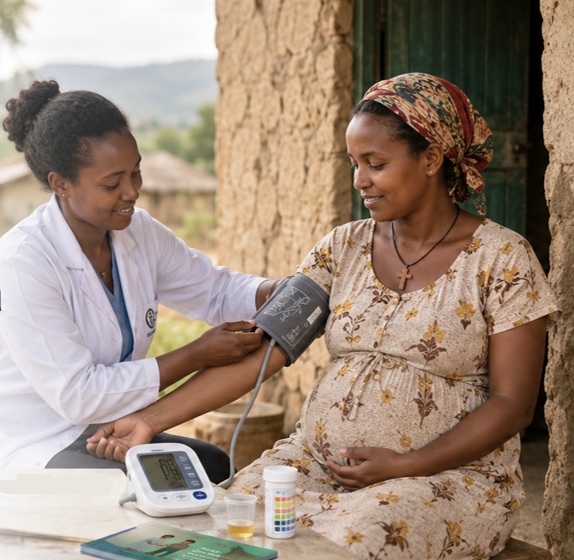
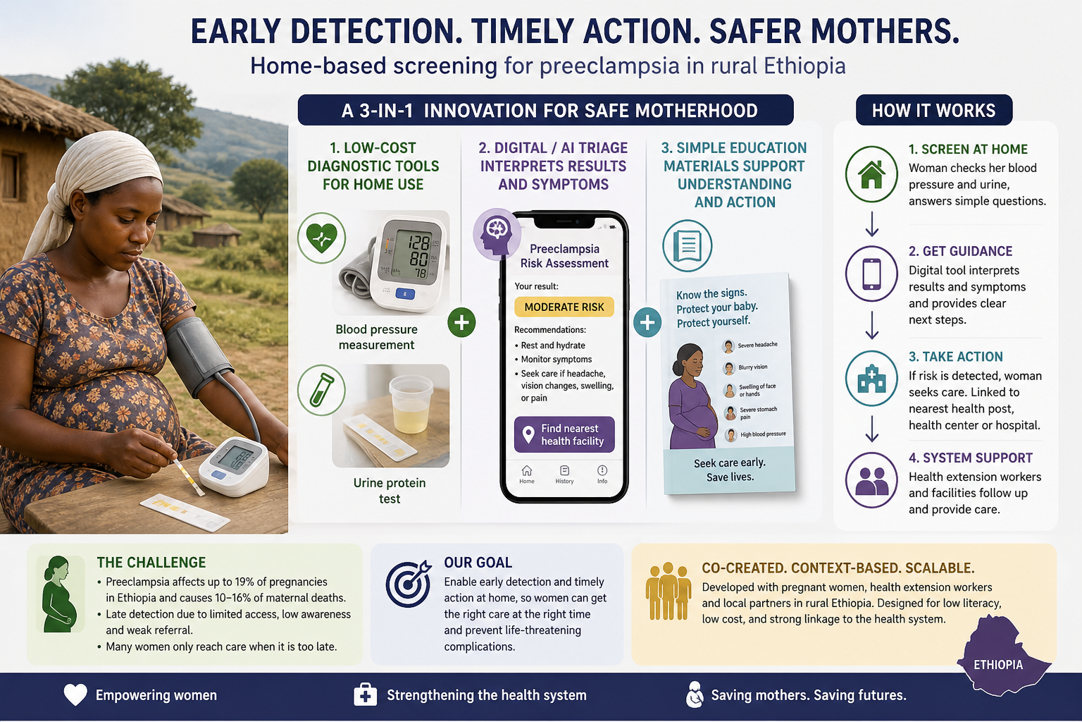
Q-Point, Hawassa University and Orbit Health are therefore assessing the feasibility of a women-centred system for home-based screening and referral support. The concept combines affordable blood pressure measurement, urine protein testing, visual guidance for women with limited literacy and simple support for assessing risks. It will connect with the work of Health Extension Workers (HEW’s) and existing healthcare and referral pathways.
The innovation will not replace antenatal care, clinical diagnosis or treatment. Instead, it aims to help pregnant women and local health workers recognise possible risks earlier and arrange appropriate care more quickly.
Project goal and outputs
The project will determine whether an integrated home-based screening and referral support system can be technically feasible, safe, affordable and easy to use in rural Ethiopia. It will also assess whether women understand and accept the system, whether it fits the local health system and whether public organisations and development partners could implement it at scale.
The project will deliver:
- An overview of the relevant clinical, regulatory, ethical and data requirements.
- Evidence on pregnant women’s needs and the system’s fit with local care and referral pathways.
- A comparison and selection of suitable, low-cost blood pressure devices, urine protein tests and supporting materials.
- A decision on the most suitable form of guidance, such as paper-based instructions, SMS or USSD, an offline mobile application or a hybrid approach.
- Visual mock-ups, triage messages and an initial service blueprint in co-creation with women and health-system actors.
- A practical model for the role of HEW’s in training, follow-up and referral.
- An initial business case covering cost scenarios, potential buyers, financing routes and options for institutional adoption.
- A Phase 2 roadmap for prototype development and field testing, including technical specifications, partner roles, risks and go/no-go criteria.
At the end of the phase 1, the consortium will be able to make an evidence-based decision on whether the concept is ready for further development and testing in rural communities in Sidama (phase 2).
Relevant Sustainable Development Goals (SDGs)
- SDG 3 – Good Health and Well-being: The project supports earlier recognition of pregnancy-related risks and faster referral to appropriate care, helping to improve health outcomes for mothers and unborn children.
- SDG 5 – Gender Equality: The innovation addresses a health condition affecting pregnant women and responds to gender-related barriers such as restricted mobility, low health literacy and limited decision-making power.
- SDG 9 – Industry, Innovation and Infrastructure: The project combines existing medical tools and local health structures into an innovative and accessible service model for underserved areas.
- SDG 10 – Reduced Inequality: By bringing screening closer to women’s homes, the project aims to reduce inequalities in access to antenatal care between remote communities and better-connected areas.

Involved organisations
Hawassa University is the Ethiopian clinical and public health research partner. It contributes expertise in maternal health, preeclampsia, ethics, community-based research and the Ethiopian health system. Through Hawassa University Comprehensive Specialized Hospital and the Dale-Wonsho Health and Demographic Surveillance System, the project can draw on relevant clinical, community and institutional expertise in Sidama.
Orbit Health is the Ethiopian private partner in digital health and innovation. Orbit health contributes expertise in digital health systems, data streams and AI-driven support instruments for health professionals, integrated in the local Ethiopian context.
Commissioner
The Netherlands Enterprise Agency (RVO), through the SBIR in Developing Markets programme. The programme supports the development of innovative and economically viable solutions to societal challenges in emerging markets.
Duration
August 2026 – January 2027
Impression of the project
Curious to know more?
These Q-Point experts are involved and happy to talk to you:
Carel Jaspers
Directeur Q-Point
More about Carel
Maaike Broeksma
Adviseur duurzame en inclusieve agro- en levensmiddelenketens
More about Maaike
Feline Heussen
Adviseur duurzame en inclusieve agro- en levensmiddelenketens
More about Feline
Call us at +31 (0)317 491581 or send an email to info@q-point-bv.nl